Choosing the right business structure is one of the most important decisions when starting or running a business in Australia. The structure you choose affects how much tax you pay, your legal responsibilities, and how easily your business can grow.
Two of the most common business structures in Australia are sole trader and company. Each has different tax implications, costs, and benefits. In this guide, we explain the key differences between these structures and help you understand which one may save you more tax.
If you are unsure which structure is best for your situation, Future Accounting & Taxation Services can help you evaluate your options and set up the most tax-efficient structure for your business.
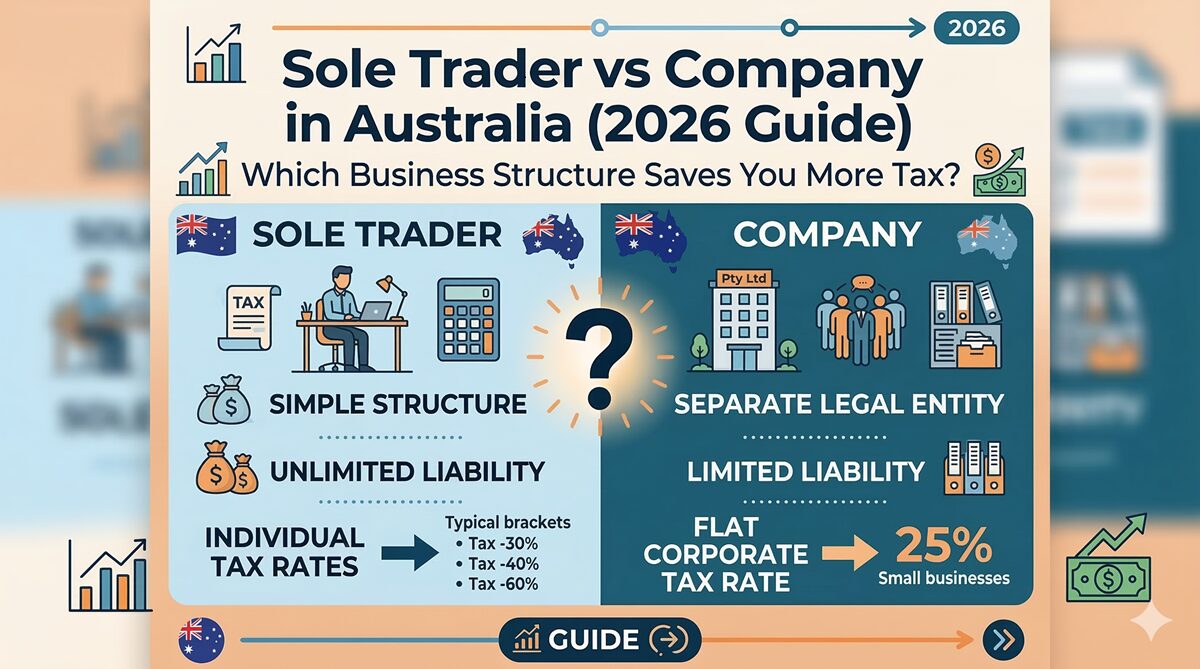
A sole trader is the simplest and most common business structure in Australia. In this structure, the business and the owner are considered the same legal entity.
As a sole trader, you operate the business under your own name or a registered business name, and you are personally responsible for all business income, debts, and liabilities.
Many freelancers, consultants, and small service providers begin their business as sole traders because it is simple and has fewer compliance requirements.
A company is a separate legal entity registered with the Australian Securities and Investments Commission (ASIC). This means the business has its own legal identity separate from its owners (shareholders).
Companies provide more structure and legal protection, but they also come with additional administrative and compliance responsibilities.
Companies are often used by businesses planning to grow, hire employees, or manage larger profits.
Sole traders pay tax at individual income tax rates, which can range from lower tax brackets up to the highest marginal tax rate depending on income.
Business income earned by a sole trader is added to their personal income and taxed accordingly.
The tax rates depend on the individual’s total taxable income. As income increases, the tax rate also increases.
For example:
Sole traders may also be required to pay the Medicare levy.
Sole traders can claim various business expenses such as:
These deductions help reduce taxable income and lower the overall tax payable.
Companies are taxed differently from individuals. Instead of personal income tax rates, companies pay a corporate tax rate.
For many small businesses in Australia, the company tax rate is generally lower than the highest individual tax rates.
Companies can:
When dividends are distributed, shareholders may receive franking credits, which represent tax already paid by the company.
This system prevents double taxation and can be beneficial in certain financial situations.
One of the most common questions business owners ask is whether operating as a company saves more tax than being a sole trader.
The answer depends largely on the level of profit generated by the business.
A sole trader structure may be suitable when:
For many freelancers or small service providers, operating as a sole trader can be cost-effective in the early stages.
A company structure may be more beneficial when:
Companies can also offer greater tax planning opportunities through dividend distribution and income structuring.
Another major difference between sole traders and companies is liability.
As a sole trader, you are personally responsible for all debts and obligations of the business. This means personal assets may be at risk if the business faces financial difficulties.
Companies provide limited liability protection, meaning shareholders are generally not personally responsible for company debts.
This protection is one reason many growing businesses transition from sole trader to company structures.
While companies may provide tax and legal advantages, they also come with higher compliance obligations.
Because of these requirements, companies often incur higher accounting and administration costs.
Many businesses start as sole traders and later transition to a company structure as they grow.
You may consider switching when:
A professional accountant can help determine the right timing for restructuring your business.
Choosing the correct business structure requires careful analysis of your financial situation, long-term goals, and tax obligations.
Future Accounting & Taxation Services provides expert accounting and taxation advice for individuals and businesses across Australia.
Our services include:
Led by Lalji, an experienced accountant with more than 16 years of professional experience, the firm helps clients make informed financial decisions and ensure compliance with Australian tax regulations.
Both sole trader and company structures offer advantages depending on your business size, income level, and growth plans.
Sole traders benefit from simplicity and lower administrative costs, making it a suitable option for many small businesses and freelancers.
Companies, on the other hand, provide tax planning opportunities, asset protection, and scalability for growing businesses.
Understanding these differences can help you choose the structure that best supports your financial goals and long-term business success.
If you are unsure which structure is right for your business, professional advice can make the decision much easier.
Not always. The best structure depends on income levels, risk exposure, and business goals.
Many business owners consider transitioning once profits increase significantly and tax planning becomes more important.
Yes. Many businesses begin as sole traders and later restructure as companies as they grow.
Not necessarily. While corporate tax rates may be lower, other factors such as dividend taxation must also be considered.
Freelancers often start as sole traders due to simplicity, but may transition to companies as their income and client base grow.
30 Maguire Avenue
Beechboro, WA, 6063
Australia
Monday - Friday 08:00AM - 5:00PM
Saturday - Sunday By Appointment only
© 2026 All Rights Reserved.